
Top 5 YouTube Videos Every Indian EdTech Founder Should Watch
5 minutes

Discover 5 YouTube videos for Indian EdTech founders covering PhysicsWallah, BYJU'S, Cuemath, business models, student acquisition and sustainable growth.
If you are building an EdTech company in India, there is more to learn from studying how education businesses acquire students, build trust and manage costs than from watching generic startup advice.
These 5 videos and founder discussions examine real questions: Why did some EdTech companies struggle despite raising billions? How did PhysicsWallah build an audience before launching its paid platform? What does it take to build an education business over the long term?
Here are the videos worth adding to your watchlist.
1. Why Are Giant EdTech Companies Failing in India? — Think School
Watch: Why are GIANT Edtech companies FAILING in India?
3 key takeaways
Growth is not the same as a healthy business. Student acquisition, operating costs and monetisation need to work together.
Funding cannot fix a weak model indefinitely. A company must eventually make its economics sustainable.
Trust matters in education. A strong brand still needs to deliver value to students and parents.
Why watch it: Start here if you want to understand the problems that emerged during India's EdTech boom. The video was published in 2022, so use it to study the period's business failures, not as a current market report.
2. How PhysicsWallah Won India's EdTech War — Backstage with Millionaires
Watch: How PhysicsWallah WON India's EdTech War

3 key takeaways
Free content can be a customer acquisition channel. PhysicsWallah began by building an audience through teaching on YouTube.
Affordability can shape positioning. A product designed for a price-sensitive audience can compete differently from premium alternatives.
The transition from content to product matters. A large audience needs a relevant paid offering and a delivery system that supports students.
Why watch it: This is a useful case study of the Indian EdTech market, including PhysicsWallah's approach and the weaknesses exposed in competing models.
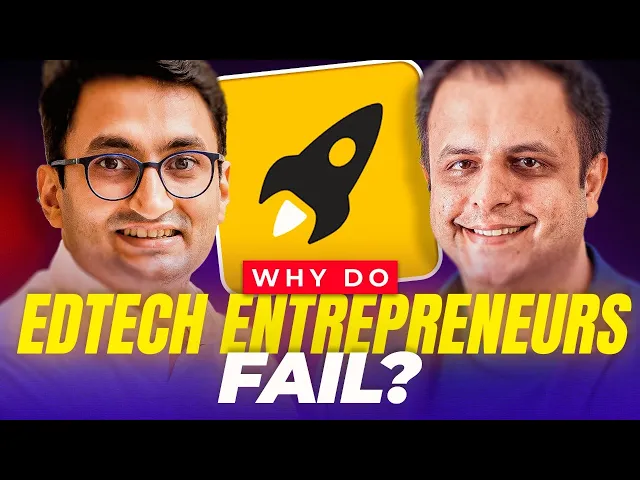
3. Why Do EdTech Entrepreneurs Fail? — Manan Khurma, Founder of Cuemath
Watch: The Reasons Why Entrepreneurs Fail! — The Neon Show
3 key takeaways
Education is a long-term business. Trust and learning outcomes take time to establish.
Performance marketing has limits. Paid acquisition should not be mistaken for durable demand.
Study the distribution model. Understand how the business reaches families, acquires students and sustains delivery.
Why watch it: Manan Khurma discusses building Cuemath, customer acquisition, education business models and the realities of scaling an education company.
4. Capturing the India Market: Building Scale — ASU+GSV Summit
Watch: Capturing the India Market: Building Scale

3 key takeaways
Define the target market precisely. India's education market is not one uniform customer segment.
Think about pricing and unit economics. Scale needs to be supported by a workable commercial model.
Evaluate distribution choices. Online, offline and institutional partnerships can have different costs and constraints.
Why watch it: This panel specifically examines the challenges of scaling in India, including target markets, pricing, unit economics and public-private partnerships.
5. Decoding BYJU'S Journey and Future Ambitions — TechCrunch Disrupt
Watch: Byju Raveendran on BYJU'S Journey and Future Ambitions

3 key takeaways
Study how a teaching-led business scales. Consider how an individual educator's reach can become a larger learning product.
Examine expansion decisions. Acquisitions and new markets can accelerate growth but also add complexity.
Separate ambition from execution. Plans should be evaluated against what the business ultimately delivers.
Why watch it: The 2020 discussion captures BYJU'S thinking during its high-growth period. Watch it as a historical case study, not as current strategic guidance.
Which two should you watch first?
If you are short on time, start with these:
Think School's EdTech failure analysis — understand the risks of scaling too quickly.
Manan Khurma on Cuemath — understand why education businesses require trust and long-term execution.
The bigger lesson for Indian EdTech founders
The most useful question is not which founder has the most inspiring story. It is which business decisions created lasting value for students and made the company sustainable.
Look closely at how each company acquires learners, converts free users into paying customers, prices its programmes, delivers learning outcomes and manages operating costs.
Then compare those choices with your own business. A strategy that works for a large exam-preparation platform may not work for a small professional-skills institute or a B2B education platform.
The objective is to learn the underlying principles—not copy another company's playbook.
Let's connect to discuss more?
Whether you collect fees, EMIs, subscription payments, memberships, rent or B2B collections, SlashCollect automates the repetitive work behind payment collection.