Payment Links vs Recurring Payments: How Indian Businesses Can Collect Payments Faster
8 minutes
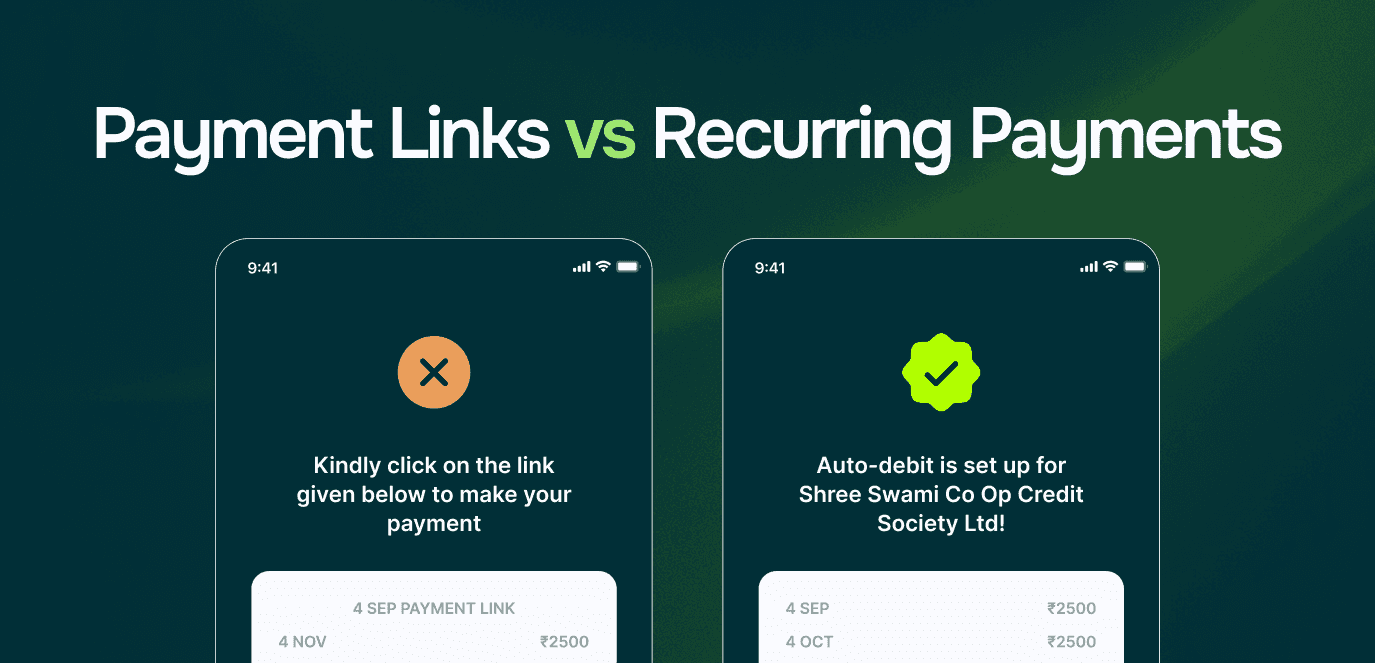
Payment links work well for one-time collections. Recurring payments work better when customers need to pay every month. Learn how Indian businesses can combine payment links, UPI payments and UPI AutoPay to create a faster, more secure and more scalable payment collection process.
The Right Payment System Depends on How Your Customer Pays
Every business wants the same thing:
Collect payments from customers quickly, securely and with as little manual effort as possible.
But not every payment is the same.
A customer buying a product once needs a simple payment link.
A customer paying ₹5,000 every month needs something different.
They need a payment plan and recurring payment setup.
This distinction matters because sending a fresh payment link every month still requires the customer to remember, open and complete the payment every time.
A recurring payment does not.
With UPI AutoPay, for example, a customer can authorise a recurring mandate and scheduled payments can subsequently be collected according to the mandate. NPCI supports recurring use cases including EMIs, insurance, subscriptions and other scheduled payments.
So the question for businesses isn't simply:
"How do I accept a payment?"
It is:
"How should I collect this payment?"
Payment Link vs Recurring Payment
A payment link is a shareable link that takes a customer to a payment page.
You can create a payment link and share it through:
WhatsApp
SMS
Email
Website
Social media
Other digital channels
The customer clicks the link and completes a UPI payment or another supported payment method.
A recurring payment works differently.
Instead of asking the customer to make every payment manually, the business can set up recurring payments through an authorised mandate.
Simple example
Payment link
Pay ₹5,000 here → customer clicks → customer pays.
Next month:
Send another link → customer clicks → customer pays again.
Recurring payment
Customer approves the payment plan once → scheduled payments are collected automatically.
For businesses collecting the same customer payment repeatedly, this difference can be significant.
When Should You Use a Payment Link?
Payment links are ideal when the payment is one-time or irregular.
For example:
One-time purchase
₹15,000 for a product or service.
Invoice collection
A customer has an outstanding ₹40,000 invoice.
Advance payment
A customer needs to pay ₹10,000 to confirm an order.
Ad-hoc payment
A customer needs to make a payment that doesn't follow a regular schedule.
In these cases, the simplest workflow is:
Create a payment link → share the link → collect payment → reconcile
Payment links are particularly useful for businesses that don't have a full website or checkout flow and still want to collect digital payments from customers.
When Should You Use Recurring Payments?
Recurring payments make more sense when the customer needs to pay monthly, quarterly or on another defined schedule.
Common examples include:
Education fees
Loan EMIs
Insurance premiums
SaaS subscriptions
Gym memberships
Society maintenance
Recurring deposits
Professional retainers
Subscription services
Instead of repeatedly asking:
"Please make this month's payment."
the business can set up a payment plan once.
NPCI specifically positions UPI AutoPay for recurring payment use cases and gives merchants multiple recurrence-frequency options.
What Is UPI AutoPay?
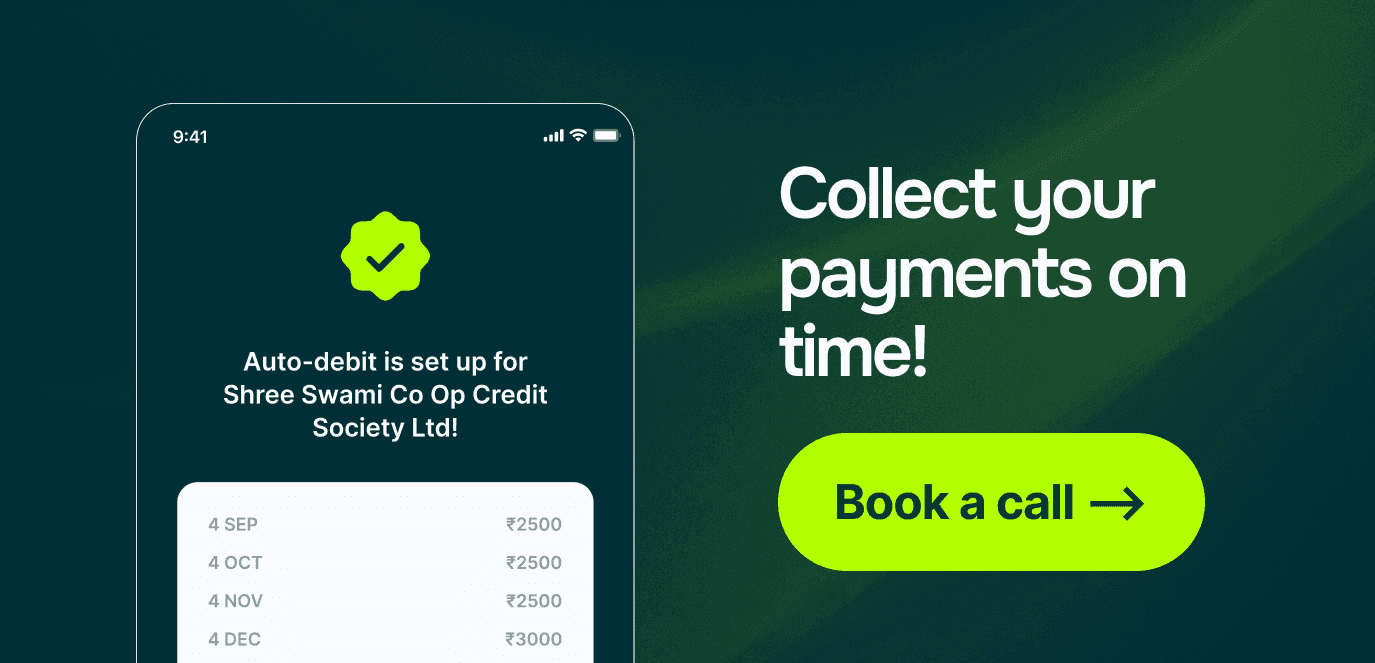
UPI AutoPay allows customers to create an e-mandate for recurring payments through a UPI application.
The customer authorises the mandate and subsequent payments are executed according to the agreed schedule.
Customers can also manage supported mandates through their UPI apps, including actions such as pause, unpause, modification and revocation.
For businesses, this creates an important shift:
From payment collection to payment automation.
And the timing is significant.
NPCI's statistics show UPI processed 24.5 billion transactions in August 2026, following 23.7 billion in July and 22.7 billion in June.
UPI is no longer simply another digital payment option for Indian businesses. It is a core payment system.
Why Payment Links Still Matter
Recurring payments aren't a replacement for payment links.
You need both.
A strong payment system for businesses should be able to handle different collection scenarios.
For example:
Requirement | Best-fit approach |
|---|---|
One-time ₹5,000 payment | Payment link |
Monthly ₹5,000 payment | Recurring payment |
Customer missed an instalment | Payment link |
₹10,000 × 12 months | Payment plan + recurring mandate |
Ad-hoc invoice | Payment link |
Regular EMI | UPI AutoPay / NACH |
The best collection stack doesn't force every customer into one payment flow.
It gives the business the right tool for the right payment.
How to Create a Payment Link
The basic process is straightforward.
1. Define the payment
Enter the amount, customer details and reason for payment.
2. Create the payment link
The system generates a unique link for the customer.
3. Share it
Send the link through WhatsApp, SMS, email or another channel.
4. Customer pays
The customer opens the link and completes the payment.
5. Track and reconcile
The business should be able to see whether the payment was created, paid, pending or failed.
The important part isn't just the ability to set up a payment link.
It is what happens after the link is sent.
Does the system tell you if the customer paid?
Does it send reminders?
Can you identify unpaid links?
Can the payment be automatically reconciled?
That's where payment technology starts creating operational value.
Payment Collection Is More Than Sending a Link
A common mistake is thinking:
Payment link = payment collection system.
It isn't.
A payment collection process includes:
Due creation → Customer notification → Payment → Confirmation → Reconciliation → Recovery
Suppose you send 1,000 payment links.
You still need to know:
How many were opened?
How many were paid?
Who hasn't paid?
Which payments failed?
Who needs a reminder?
Which payment belongs to which customer?
What is still outstanding?
A proper payment collection system connects all these steps.
Payment Reconciliation: The Part Businesses Often Underestimate
Collecting money is only half the job.
You also need to know whose payment it is and what it was for.
Imagine receiving 500 UPI payments into a bank account.
Without proper payment reconciliation, the finance team may have to manually match:
Transaction → Customer → Invoice → Amount → Account
That creates unnecessary work and increases the chance of errors.
Modern collection systems can help connect payment status with customer and transaction records, making reconciliation much easier.
For businesses handling large payment volumes, this becomes increasingly important.
A successful payment should automatically become a correctly recorded payment.
Secure Payment Systems Matter
Convenience is important.
Security is non-negotiable.
Businesses handling customer payments need secure payment systems that protect payment information and use appropriate authentication and regulatory controls.
UPI itself is built around secure authentication, including UPI PIN-based authentication, and NPCI describes UPI as a system offering secure merchant payments without requiring users to share sensitive bank credentials with merchants.
For businesses, the takeaway is simple:
Don't build payment collection around customers sharing bank details or sending screenshots.
Use proper payment systems.
What About "Pay in 3"?
Not every customer wants to pay everything upfront.
This is where payment plans for customers become useful.
A business might structure:
₹30,000 total
Pay in 3:
₹10,000 today
₹10,000 next month
₹10,000 the following month
The key is to distinguish between two concepts:
Split payment plan
The customer agrees to multiple scheduled payments.
Recurring payment
The customer authorises future payments to happen automatically.
A business can combine both:
Create a payment plan → customer authorises recurring payments → instalments are collected automatically.
This is particularly useful for education, professional services, memberships and other businesses with instalment-based pricing.
The Best Collection Stack Combines Both
For most growing businesses, the ideal setup is not:
Payment link OR recurring payment.
It is:
Payment link + UPI + recurring payments + payment plans + recovery + reconciliation
Here's what that looks like:
One-time payment
Create payment link → UPI payment → confirmation
Recurring payment
Payment plan → UPI AutoPay → automatic collection
Failed payment
Failed transaction → retry → payment link → recovery
Customer needs flexibility
Existing plan → revised payment schedule → new collection plan
This creates a complete digital payment system rather than just a payment button.
Payments on the Go: Why Mobile Matters
Customers increasingly pay from their phones.
That makes payments on the go an important part of the payment experience.
A customer should be able to receive a link on WhatsApp, click it on their phone and complete a UPI payment without navigating a complicated desktop checkout.
UPI was designed around mobile payments, with NPCI highlighting instant mobile payments, QR and intent-based flows as core capabilities.
For Indian businesses, mobile-first payment collection isn't an extra feature. It's table stakes.
A Better Way to Collect Payments from Customers
Let's put everything together.
A business with both one-time and recurring customers could use this structure:
Step 1: Create the payment
Either generate a payment link or create a recurring payment plan.
Step 2: Let the customer choose
For recurring businesses, offer an appropriate mandate such as UPI AutoPay or another supported recurring method.
Step 3: Automate collection
Scheduled payments are collected according to the agreed plan.
Step 4: Recover failures
Don't immediately treat every failed payment as lost revenue.
Retry or provide another way to pay where appropriate.
Step 5: Reconcile automatically
Match successful payments with the correct customer and outstanding amount.
Step 6: Track everything
Finance and operations teams should have visibility into:
Collected → Pending → Failed → Recovered → Outstanding
That is what modern payment technology should accomplish.
How SlashCollect Brings It Together
SlashCollect is built for businesses that need more than a basic payment gateway.
With SlashCollect, businesses can build structured collection workflows around:
Payment links for one-time or exception payments.
Payment plans for customers paying in instalments.
UPI AutoPay and NACH for recurring collections.
Automated payment workflows to reduce manual follow-ups.
Payment recovery when scheduled payments fail.
Collection visibility and reconciliation to keep finance teams in control.
The result is a collection stack that helps businesses move from:
"Please pay this invoice."
to:
"Here's your payment plan. Payments happen automatically, and we'll handle the exceptions."
Payment Systems for Businesses Are Moving From Transactions to Collections
The Indian payment ecosystem has made accepting a digital payment extremely easy.
UPI alone processed more than 24 billion transactions in August 2026.
But accepting payments is only the first layer.
The larger opportunity is building systems that help businesses collect, recover and reconcile payments at scale.
That's the difference between a payment tool and a collection platform.
A payment tool helps a customer pay.
A collection platform helps a business get paid predictably.
Final Thought
If your business collects money from customers only once, a simple payment link may be enough.
But if customers need to pay monthly, pay in 3, pay instalments or make recurring payments, the collection process needs to be more sophisticated.
The ideal setup is simple:
Payment link for one-time payments.
UPI for fast digital payments.
UPI AutoPay for recurring payments.
Payment plans for instalments.
Automation for follow-ups and recovery.
Reconciliation for financial control.
And all of it should sit inside a secure payment system designed around the way your customers actually pay.
That's where SlashCollect comes in.
Frequently Asked Questions
How do I create a payment link?
A payment link is generally created through a payment platform by entering the payment amount and relevant customer or transaction details. The generated link can then be shared with the customer through channels such as WhatsApp, SMS or email.
What is a recurring payment?
A recurring payment is a payment that occurs automatically according to a predefined schedule after the customer has authorised the recurring arrangement.
How do I set up recurring payments in India?
Businesses can use recurring payment mechanisms such as UPI AutoPay and NACH, depending on their use case and eligible setup. UPI AutoPay allows customers to create e-mandates through UPI applications.
Is a payment link secure?
A payment link can be part of a secure payment flow when it is generated and processed through a trusted payment infrastructure with appropriate authentication and security controls.
What is UPI AutoPay?
UPI AutoPay is NPCI's recurring payment mechanism that allows customers to authorise scheduled payments through UPI. It supports use cases including EMIs, subscriptions, insurance and other recurring payments.
Can I use a payment link for monthly payments?
You can use a payment link to collect a monthly payment, but the customer generally still needs to take action for each payment. For genuinely recurring collections, a mandate-based solution such as UPI AutoPay may be more suitable.
Let's connect to discuss more?
Whether you collect fees, EMIs, subscription payments, memberships, rent or B2B collections, SlashCollect automates the repetitive work behind payment collection.